

Advocates Question Spike in Portland Police Response Times Amid Controversial Funding Campaign
With a dramatic increase in 911 response times over the past five years, police blame staffing and other factors, but the data paints a troubling picture

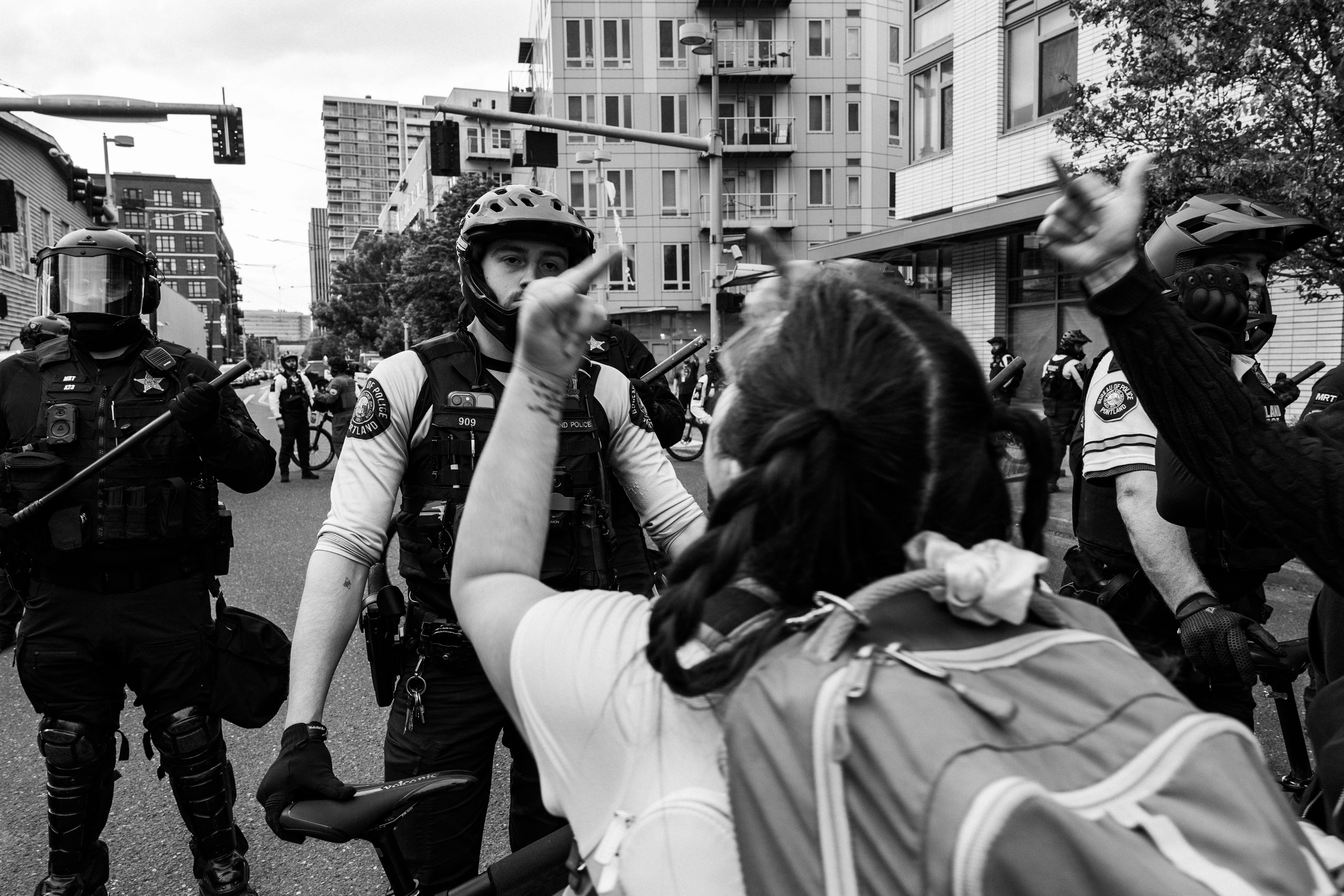
Portland for All, a community-based nonprofit, raised concerns around Portland Police response times in early June, citing a 182% increase from 2020 to 2025 versus an 11% increase in Portland Fire and Rescue response times over the same period, despite relatively stable staffing in both departments. A recent report commissioned by Portland City Council raises further questions, noting that the number of dispatched calls for Portland Police fell during the same time period.
The troubling datapoint garnered attention around the same time dozens of complaints prompted a state investigation into the “Safer Portland” campaign, which seeks signatures for a ballot measure to divert 25% of the Portland Clean Energy Fund (PCEF) to hire more police.
Advocates and community members have questioned the petition’s aims.
“When we looked at the data, we were really shocked to see that historically there was once a correlation between staffing and response time, but in recent years, they have become completely divorced,” said Andrés Oswill, a volunteer and board member with Portland for All.
At the center of the issue with the Safer Portland campaign is the apparent lack of connection between staffing and response times. Because the petition does not outline how it would lower 911 wait times or improve mental health outcomes, the complaints allege campaign canvassers are misleading the public by suggesting it would do so.
Sergeant Kevin Allen, the Portland Police Bureau’s (PPB) public information officer, cited various reasons response times could be faltering, including retirements, changes in tactics to focus on de-escalation, and limited non-trainee patrol officers.
“There are currently 90 officers within some phase of their training,” Allen told Last Week in Hell, making up around 16% of PPB’s 572 officers. “Trainees do not handle calls by themselves, so [they] do not have a positive impact on response time and also do not increase the capacity to take more calls.”
Allen was not immediately able to retrieve data on the proportion of officers in training year-over-year, but data presented in the city’s staffing report shows limited variance from 2023 to 2026. Trainee staffing proportions obtained through the Wayback Machine also indicate minimal variance relative to the increase in response times. For example, the PPB staffing page, updated on June 30, 2026, indicates PPB has 572 officers with 89 in training, meaning 483 non-trainees. In July 2022 and June 2024, there were 454 and 444 non-trainees, respectively.
These numbers can vary month-by-month, but they do not appear to clearly explain the response time spike.
Allen also pointed to an increase in shifts that could not be filled to minimum staffing levels, even with time-and-a-half overtime pay. In such cases where patrol districts are not fully staffed, Allen says shift managers will often double-up officers in partner cars to address safety concerns, which can increase response times.
In contrast, the city’s staffing report demonstrates factors that should have lowered response times in the past few years, such as Portland Street Response taking on around 14,000 calls starting in 2023 and 12,000 in 2024, calls that would have previously gone to PPB. The total number of dispatched calls also fell across the board since 2018—high-priority dropped 31%, medium-priority 18%, and low-priority 3%.
With a consequential campaign that would see hundreds of millions in climate dollars go to police, these numbers have been hard for advocates to overlook. In their original post in early June, Portland for All called for answers and accountability from city officials.
“We know that funding and staffing have been a rallying cry for the police union, but the cost per call has been going up even while response times have grown longer and longer,” Oswill told Last Week in Hell. “If you’re not seeing a correlation between funding and staffing and call response, then the basic argument of the [Safer Portland] measure doesn’t make sense.”
As a representative of PPB, Allen could not comment on Safer Portland, but he maintains PPB cares deeply about response times and that they are taking a data-driven approach to policing, which in some cases may mean longer response times in exchange for more effort in crime prevention or other areas.
Barring legal contention, if the Safer Portland campaign can turn in around 40,000 signatures by July 6, the initiative will be on the ballot in November. While the city’s staffing and recruitment report attests to the delicate balance of resources in policing, indicating that staffing increases could improve 911 response times, it remains unclear how much of a difference the Safer Portland measure would make given the deterioration of response times with stable staffing over the past five years.
“This isn’t a ‘defund the police’ conversation,” Oswill said. “This is ‘we need the right person to respond to a call in a timely way,’ and that’s not happening. This smoke and daggers ballot measure that, one, is intentionally misleading voters in how they’re framing it, and two, isn’t actually solving the problem, doesn’t do anything to get us closer to people being safe and having their needs addressed.”